The Delphi method has a connection to Socrates’ (circa 470-399 BCE) questioning and dialogical philosophy recognized by many, but few know that the connection is also historical. Socrates’ friend Chaerephon actually inquired of the Oracle of Delphi whether anyone was wiser than Socrates. The Oracle responded negatively. Socrates, not simply accepting the statement, embarked on a quest to find someone wiser than himself. To this end, he roamed marketplaces, gymnasiums, and craftsmen’s workshops, engaging in discussions with the Athenians he encountered.
The Socratic Method
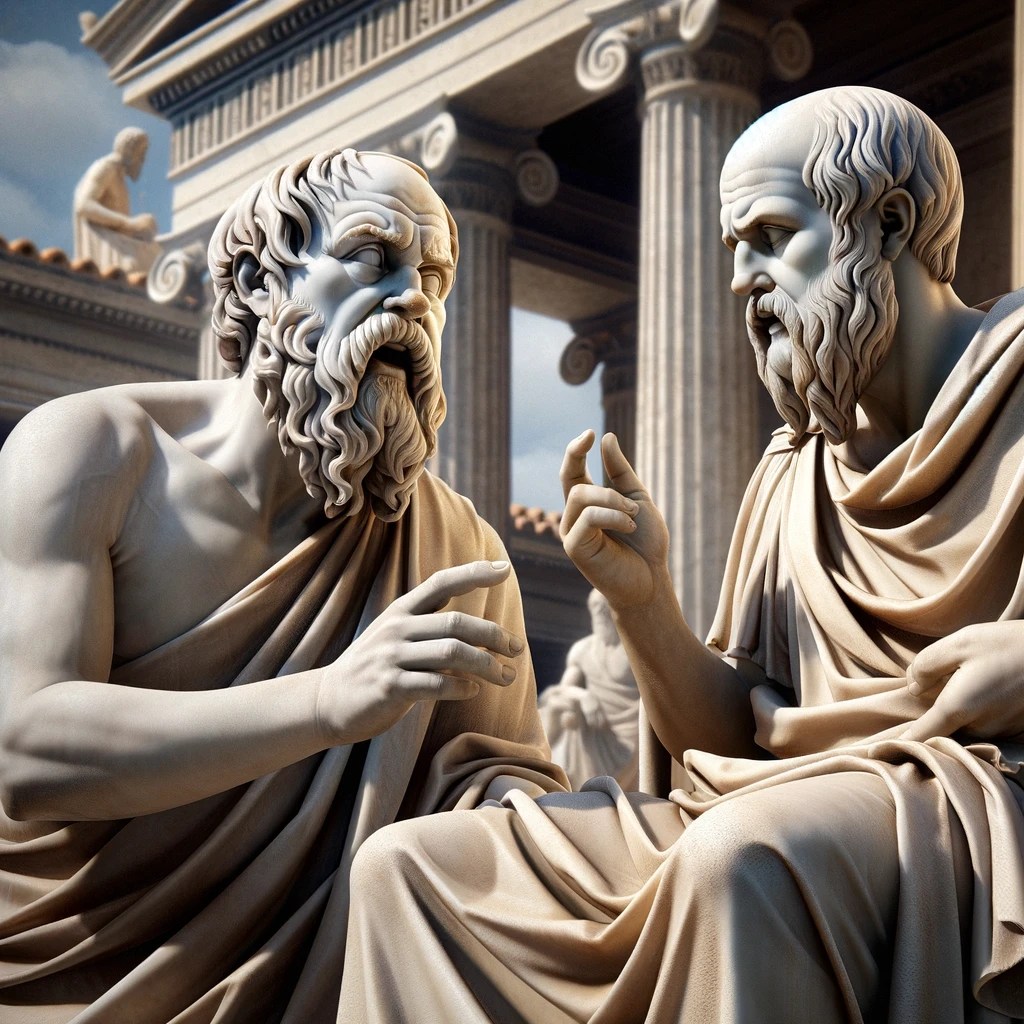
In his debates, Socrates questioned people’s knowledge of the good, virtue, and beauty. He developed a questioning method where he pretended to be ignorant himself and asked for instruction from others to gain knowledge. Socrates continued his questioning until his interlocutor reached a dead end with the premises of their original thought. The goal, however, was not to humiliate the other party but to guide them towards more consistent thinking. A dead end is often a necessary condition for unreflected concepts to seek a new direction.
Through his conversations, Socrates sought to develop concepts and their definitions, recognizing that reality is shaped not only in the mind but also in language. The Socratic method is sometimes referred to as the maieutic method (maieutikos), because Socrates believed that knowledge of the truth lies dormant within all people, and through dialogue initiated by questions, the inquirer can help ”birth” truthful thoughts. By using this method, a skilled teacher can teach their students to think for themselves. In the Meno dialogue, Socrates ”proves” his point by prompting an uneducated slave boy to define a geometric theorem through questioning.
Socrates’ philosophy remains relevant and clear, yet suitably naive. Of course, our understanding of reality, truth, and the future has changed over 2500 years. The world around humans was a mystery that required much more imagination to explain than now. The differences in human and inter-human activities are less significant. According to current understanding, humans represent an evolutionary stratum that reflects reality and is also capable of significantly shaping it. Humans have a powerful symbolic tool for this task, language, whose significance Socrates also realized. Outside of language games, the playing field of ancient humans was limited by the whims of nature and gods.
Language detaches humans from immediate experience and allows for the examination of reality as if the observer were outside of it. In a strict epistemological sense, this is as much a fantasy as anything we write or claim about the future. Alongside truth, the pursuit of what is considered desirable but not yet achieved is valued. Such can only be realized in the future. In this regard, 2500 years is but a blink of an eye, during which the setup has not changed at all. Managing the future is rhetoric but even more so politics. Delphi is a technique in this setup that ensures the foundational work of rhetoric and politics is properly and carefully done.
When we speak or write, we not only make true or false claims about the world but also produce new conceptions and meanings or reinforce old ones. This is especially true for matters of the future, about which true claims or certain observations cannot even be made. This does not – and should not – prevent efforts to influence how reality or the future is perceived. Both truth and the future can be approached by means considered by ancient philosophers. It’s natural to build a bridge from their thoughts to what the modern Delphi method can aim to achieve, realizing along the way how much the future has to learn from the past.
Apollo’s Center for Future Studies
In the golden age of Ancient Greece, the Delphi temple was a place of consultation for both personal and state matters. Travelers were abundant as each generation wanted to know in advance about harvests and warfare fortunes. Apollo’s Center for Future Studies maintained its brand and significance for hundreds of years. To the ancients, there was only one future but many gods. Later, things turned upside down. The Oracle of Delphi ran out of work with the spread of Christianity, as a monotheistic future became the prevailing belief. It took almost 2000 years before the world secularized enough for the future to start appearing plural.
Today’s futurist believes in multiple futures. The evolution of the Delphi method reflects this development. Initially, the Delphi technique aimed at consensus, which could be seen as producing one probable and desirable future. The big difference to antiquity is that even in consensus Delphi, the future is a target of action rather than adaptation. Subsequently, variations of the Delphi technique have been developed to open up several future potentials, where seeking multiple possible and justified futures, depicted in scenarios, is more important than achieving unanimity.
In ancient Delphi, among other deities, the Earth goddess Gaia was also worshiped. According to legend, Gaia’s sanctuary, or Pytho, was guarded by a huge serpent, from which pythons got their name. The lives of the gods resembled contemporary soap operas with their scheming and plot twists. One day, envious of Gaia, the god of light and healing killed the Python serpent and placed his own priestess, the Pythia, in Gaia’s former sanctuary. Zeus’ son Apollo appropriated the temple for himself, and from this beginning developed the nearly thousand-year Delphi institution (Ancient Greek Δελφοί, English Delphi).
Apollo’s priestesses evolved into oracles, prophets who knew the future. Delphi, in turn, became the known world’s center for prophecy. It was believed that Apollo’s virgin priestesses, under the influence of certain herbs or mushrooms, brought messages of the future directly from the god himself. It was customary for kings, warlords, and other leaders to come to Delphi to seek advice whenever a significant decision was to be made, a military campaign started, a neighboring city conquered, or any other politically important action undertaken.
Although the oracles and the power relationships of warrior leaders and princes have receded far into the past, Delphi continues to ”predict” the future. The purpose of the contemporary Delphi process is to determine the future of a particular phenomenon with the help of experts. The goal is to achieve a consensus among participants about the future to strive for. Consensus is reached by circulating opinions in the expert panel until everyone thinks the same way. Alongside the goal of unanimity, Delphi studies have increased in which multiplicity of opinions is valued, offering citizens and decision-makers the ingredients for the freedom to choose futures. Dissensus Delphis are more common in Finland than elsewhere in the world.
The temple of Delphi and modern future studies share the same function: the desire to control the future in one way or another. Contemporary Delphi is increasingly used as a means to anticipate and map the future. Such a future is seen as possibilities, alternatives, and choices. Before delving further into the ideas and possibilities of modern Delphi, let’s spend a moment longer with the thinkers of antiquity. We owe a debt of gratitude to Aristotle and Plato for how they revamped the sophists’ initiated education in rhetoric and debate.
The sophists contemplated how language and speech mediate and are mediated by reality. This contemplation continues to this day. The sophists developed a doctrine of oratory, many teachings of which are still in use. In political speech, persuasiveness and outcome were paramount, achievable equally with falsehood as with truth. The rhetorical skills honed by the sophists aimed at winning arguments, where the truthfulness of the claims presented was of little importance.
Logos, Ethos, and Pathos
Plato and Aristotle opposed the opportunistic teachings of the sophists. According to Plato, philosophy and rhetoric relate to each other as penicillin does to lipstick. Medicine focuses on healing the patient, while cosmetics focus on how the patient looks. Plato placed dialectics at the core of philosophy instead of lipstick, where truth can be found through questions and answers. Aristotle created a synthesis between dialectics and rhetoric by legitimizing both. Like Plato, he prioritized dialectic methods necessary for discovering truth, but also found rhetorical skills useful when they made reality and truth accessible to all.
Aristotle is credited with an updated rhetoric, distinguishing three known components of persuasiveness: logos, ethos, and pathos. Logos pertains to content, meanings, and arguments. Ethos serves as a source of persuasiveness based on the speaker’s intentions, character, and personal credibility. Pathos emphasizes the speaker or writer’s emotional expression and its connection to the audience’s emotions. Logos is evidently the ideational root of modern Delphi, encompassing the use of language and choice of words in forming an argument. The other elements of persuasiveness are not without significance, but they are more aligned with research setup and question formulation than with the personal actor.
What is the legacy of ancient thinkers to practitioners of modern Delphi? A good but insufficient answer is the Socratic method, which continues to inspire beyond educational and teaching institutions. Understanding often begins with an appropriate question or series of questions that delve deeper into the essence of the phenomenon under examination. Dialogue initiated by a question is a means to progress towards what is not directly accessible. Dialogue requires the conversationalists to listen and be willing to advance the other’s thought.
The discussion emphasizes the content and meanings of speech more than the personality of the speaker, which is given significant importance in the teachings of rhetoric. In modern Delphi, personal ethos – Aristotle’s ethos – is replaced by a polyphonic expert panel (modern ethos), ensuring a sufficient reserve of arguments for the Delphi process, as well as open (public) interaction that highlights the effects and motivations of different options. All essential justified perspectives and alternatives for the phenomenon under examination are represented in a correctly assembled panel.
Jürgen Habermas has described an interaction situation that expands dialogues into ”trialogues,” creating a learning community within the panel. According to Habermas, such an interaction situation presents ideal conditions for discussion. ”In the discussion, no force prevails other than the force of the better argument. A certain stance in the discussion wins only because it has the best arguments (logos, added by the author) on its side. This means that neither internal (prejudices or psychological disturbances) nor external constraints interfere with the discourse’s outcome.” (Huttunen 2014)
Ideally, a diverse panel forms a learning community capable of creatively addressing complex questions. Discussions and interpretations have a communal foundation when participants also have a stake in the phenomenon. This brings energy to discussions as participants deal with matters that also impact their own lives. Aristotle’s pathos (emotion) is replaced in modern Delphi by the question formulation’s ability to capture attention, interest, and arouse emotions. The interest (modern pathos) or even provocativeness of a question should not detract from the question’s relevance and credibility. A provocative question opens doors to other futures and discontinuities. The provocativeness of a question is a testament to the manager’s skill. Of course, the manager has other facilitation tools available to energize the panel.
Aristotle also commented on the relationship between time and rhetoric. In his rhetoric, the future is inherently political. Political speeches primarily deal with what actions should and should not be taken, operating in the future. Legal rhetoric concerns establishing the truth about past events. Historians elucidate these matters. Performative speech focuses on praising or denigrating a person or matter in the present moment. All these temporal modes of rhetoric are familiar in our reality, perhaps with the additional twist that history and the present also contain a political aspect.
Fundamentally, Delphi is about more than searching for truth and honestly depicting reality. The Oracle of Delphi implied that Socrates was the wisest man of his time. Socrates himself did not believe this and began his own quest for wisdom, which was never meant to reach a final destination. Yet, the oracle might still have been right when the posterity assesses the durability of Socrates’ thoughts. Their flight did not end with the hemlock cup he raised to his lips exactly 2420 years ago.
 METODIX
Jätä kommentti