Hannu Linturi, © Metodix Ltd, published 1.2.2024
“A technique of structuring a communication process of a group in order to help to understand and deal with the future development of a complex problem.” (Linstone & Turoff 1975)

Delphi Oracle bot Delphi Oracle Bot https://chat.openai.com/g/g-O9I0o74MC-delphi-oracle
The Delphi method can be characterized as a query or interview-based research technique in which a guided interaction process is used to gather and develop the knowledge and understanding of a group of experts, about the phenomenon under study. The method emphasizes a structured process that is based on the interaction between the managing researcher (or research team) and the panel of experts. The characteristics of the phenomenon under investigation are peeled away layer by layer, or as said in Delphi, round by round. In survey research, the first round of questioning is also the last, and unlike in Delphi, there is no elevation of the ”subjects” to interaction among themselves in a manner that can be called communal learning. This is also the ultimate aim of the manager, regardless of whether the Delphi process targets consensus or dissensus.
In the method blog series, nine articles will be published: (1) The Purposes of Delphi, (2) Steps of the Delphi Process, (3) Characteristics of Delphi, (4) The Delphi Panel, (5) The Delphi Manager, (6) Delphi Rounds (Iteration), (7) Delphi Method Connections, (8) Delphi Analysis (Future Mapping), and (9) The Future of Delphi.
In Delphi, there are two subjects of learning and main actors, which are the Delphi manager and the Delphi panel. The manager plans and facilitates the panel’s activities and analyzes its achievements. The panel consists of a diverse group of experts and stakeholders in the phenomenon under examination.
Expertise is sought from various directions, making the initial understanding of the phenomenon polyphonic in Bakhtinian terms. The multiplicity of perspectives is increased by the fact that different panelists have varying interests in the phenomenon. In modern societies, different actors are organized into interest groups, which have significant influence on societal decision-making. Business and labor organizations are at the forefront in this respect, but civil organizations also play an important role as users of societal and expert power in their own special areas.
The manager sets the research questions
The basic flow of the Delphi process is described in the diagram below. The starting point is the emergence of a research question or development need that the researcher or research team wants to investigate.

Delphi is suitable for open and complex research designs whose content or solution is unknown. Such phenomena are not hard to find in the present or the future, which is the observation point on the time axis for most Delphi subjects. The problem or unresolved issue appears in the present, but its solution or alternative solutions emerge in the future. Anticipatory thinking simplifies the dynamics of event examination to the process of seeking means from the future for the rational management of the current situation.
In the Delphi process, the Delphi manager plays a proactive key role, whose task in the initial phase is to define and target the research question together with a possible research commissioner. The manager or management team plans, implements, and reports the research. These tasks are somewhat the same as those of a traditional researcher. The difference lies in how the manager operates during the process itself. The manager’s tools include structured tasks and roles, as well as a phased iterative process, which are used to approach the research goal step by step.
The Panel and Panelists
To study the phenomenon, the manager maps out the relevant expertise and stakeholders involved. Once these are identified, a panel, i.e., a group of experts familiar with the phenomenon, is recruited as engagingly as possible. The most important characteristic of the panel, in addition to expertise, is the diversity of interests.

The expert matrix – expertise in columns and stakeholders in rows – is a means to comprehensively map potential futures. The matrix structure is also supported by Delphi software such as eDelphi (www.edelphi.org) and xDelphi (www.xdelphi.ai). Classification allows for comparisons and analyses between groups. It requires that even rare but justified views are sought to be included. In Delphi dissertations, the composition of the panel is a central factor in terms of the use and reliability of the method, in connection with which one should be prepared for challenging questions from the opponent.
The composition of the panel aims to achieve a community-level ability to examine and communicate the future development of the phenomenon through multiple interpretive frameworks and interests. The panel’s structure can be utilized when planning the course of the Delphi process and its rounds. Often, opposites can be found within the panel, whose tension is also a tool to strengthen the motivation of the panelists.
An important feature of the panel is its size, which in qualitative Delphi processes is kept relatively small (usually ranging from 15-35) to ensure ideal communication between panelists. On the other hand, in research focusing on technology foresight, panels of even thousands of experts have been used.
The Query and Questions
Before inviting panelists to the electronic panel environment, the manager must construct one or more future-oriented questions. Since the questions are aimed at the future – and thus do not have a truth value – they are formulated in such a way that the panelists’ views are distributed without elevating any one option above another. Good questions are open-ended, interesting, clear, and opinion-dividing. A question should entice a response and also motivate panelists to justify their own answer choices.
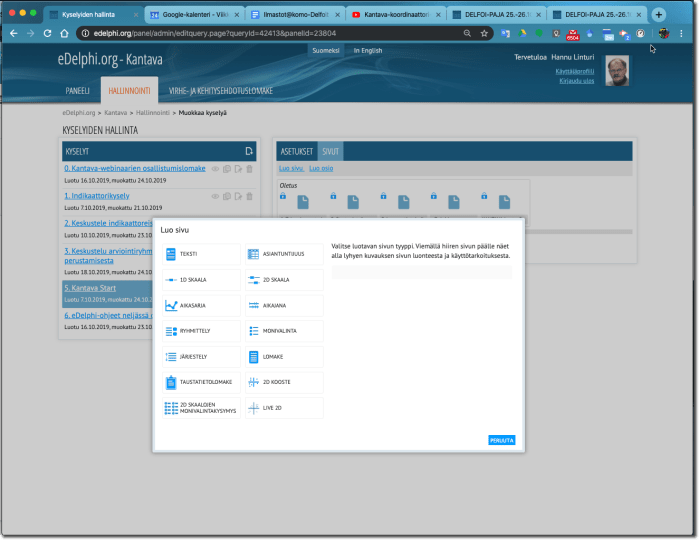
Many characteristics of a good question – such as unambiguity and comprehensibility – are the same as in any survey research. Some, however, are typical only for Delphi research. These characteristics include aspects like interest generation, the ability to create emotional connections, unpredictability, and the capacity to differentiate respondents across scales. Not all questions need to meet all possible criteria, but touches on the panelists’ intellectual and emotional personas are positive for initiating and igniting the panel.
Formulating questions is not easy. Constructing questions rewards persistent individuals who refine their questions with test respondents. An experienced researcher is often distinguished from a novice by the ability to look beyond one round to the continuation process and the potential to use the drama inherent in the panel structure in the process.
A common pitfall in question creation is producing persuasive hidden meanings. Often the manager themselves represents a recognizable expert and interest group, which influences not directly the question but the selection and direction of the topics. Negative theses are unjustly avoided, as are sharp statements. The respondent usually has a scale at their disposal to position the statement as they wish. Guidance on question formulation can be found on the Delphi developer community’s workshops.
Rounds and Process
When the manager invites the panelists to respond to the survey, the first Delphi round begins. A panelist’s response consists of two parts, the first typically being a scale answer and the second a justification for this scale choice. Panelists, on a schedule regulated by the manager, also get to see other panelists’ responses in real-time, which they can comment on, as well as change their own original answers throughout the answering period, i.e., the round.
Typically, two or more rounds are conducted in Delphi, with the questions evolving over the course of the process. A typical duration of one round is two weeks. New questions are raised from the comments and arguments of the previous round, which is why there is a gap of a few days to a week between rounds, allowing the managers time to analyze results and select new questions.
In recent years, the use of a variation known as Real-Time Delphi (RTD) has increased, where questions and answers are open in real-time throughout the entire round. In Real-Time Delphi, only one round is conducted, which translates to a one-round Delphi in Finnish.
Facilitating Delphi rounds is a showcase for the Delphi manager. Bold communication usually justifies its place. It’s important to plan the schedule in advance for how and when to communicate with the panel. Regular and relatively frequent correspondence is justified, not least because it renews the panel’s direct link, which then doesn’t need to be dug out from deep within the mailbox. Communication is enhanced if it is targeted and messages are personalized for subgroups and even individual panelists.
Analysis and Reporting
Between rounds and at the end, results are analyzed and the processed information is also shared with the panel. The content of the research report can vary from descriptions of results to action and decision recommendations, and from discourse analyses to scenarios.
Between Delphi rounds, it’s like passing a baton when the content from the previous round is harvested (analyzed) to form the basis for the next round’s questions and ”votes.” For instance, contentious issues and new initiatives generated by panelists are carried forward. With these, the research can both deepen and expand.
In the final stages of the process, at least three different paths diverge. In consensus-type Delphi, the aim is often direct decision preparation, where panel work leads to an action recommendation. In strategy preparation, options can also be left open as a basis for actual decision-making.
In scientific Delphi research, the consensus approach is used, for example, in defining pharmacological or public health quality measures. However, most often, a plural future and paths to it are developed. In scenario planning, several scenarios are deliberately created, whose probability and desirability can be tested. It is all the more significant to increase readiness for different alternatives, even when an improbable option suddenly becomes probable or a desirable one becomes undesirable.
Each Delphi draws a map of some aspect of the future, outlining the possible terrains we may be heading into. The Delphi process can also be designed as a sort of research or monitoring program, where a future map of the phenomenon is consciously formed, refined round by round, or layered in a barometer-style monitoring as has been done in the Finnish National Agency for Education’s Future of Learning 2030 barometer.

References
- Ahvenharju, Sanna (2022) Futures Consciousness as a Human Anticipatory Capacity – Definition and Measurement. Turun yliopisto. PDF Full Text https://urn.fi/URN:ISBN:978-951-29-8892-1 .
- Airaksinen Tiina, Halinen Irmeli, Linturi Hannu (2016) Futuribles of Learning 2030 – Delphi supports the reform of the core curricula in Finland. European Journal of Futures Research. Special topic: Education 2030 and beyond. Internet https://link.springer.com/article/10.1007/s40309-016-0096-y.
- Bell, Wendell (1997, 2003) Foundations of futures studies, Vol I-II, New Brunswick: Transaction Books.
- The Delphi Technique: Past, present and future prospects. Technological Forecasting and Social Change, Volume 78, Issue 9, Pages 1487-1720 (November 2011)
- Dimitrow, Maarit (2016) Development and Validation of a Drug-Related Problem Risk Assessment Tool for Use by Practical Nurses Working with Community-Dwelling Aged. Helsingin yliopisto, farmasian tiedekunta. Helsinki. Verkossa https://helda.helsinki.fi/handle/10138/167914
- Gordon, T.J. (2008) The Real-Time Delphi Method. The Millennium Project. Futures Research Methodology – V3.0. Verkossa http://www.millennium-project.org/FRMv3_0/05-Real-Time_Delphi.pdf .
- Kauppi, Antti ja Linturi, Hannu (2018) Kansalaisfoorumin viisi tulevaisuutta. Internetissä https://metodix.fi/2018/11/30/kansalaisfoorumin-viisi-tulevaisuutta/ .
- Korhonen-Yrjänheikki, Kati (2011) Future of the Finnish Engineering Education – A Collaborative Stakeholder Approach. ISBN 978-852-5633-48-1. TEK. Miktor. Helsinki. Verkossa http://www.tek.fi/ci/pdf/julkaisut/KKY_dissertation_web.pdf.
- Koskimäki Teemu (2022) Expert perspectives on achieving global sustainability with targeted transformational change. A thesis submitted for the degree of Doctor of Philosophy of The Australian National University. PDF-julkaisu https://openresearch-repository.anu.edu.au/bitstream/1885/274587/1/TK%20-%20PhD%20thesis%20-%20Revised%20version%202022%20FINAL.pdf .
- Kuusi, Osmo (2000) Delfoi-metodi. Internetissä https://metodix.fi/2014/05/19/kuusi-delfoi-metodi/ .
- Kuusi, Osmo (1999) Expertise in the Future Use of Generic Technologies. Epistemic and Methodological Considerations Concerning Delphi Studies. Interneissä http://bit.ly/3ayzN4e .
- Laakso, K., Rubin, A. & Linturi, H. 2010. Delphi Method Analysis: The Role of Regulation in the Mobile Operator Business in Finland. Phuket, Thailand: PICMET 2010: Technology Management for Global Economic Growth. 18.- 22.7.2010, 2698-2704.
- Laukkanen, Minttu (2020) Sustainable business models for advancing system-level sustainability. Acta Universitatis Lappeenrantaensis -tutkimussarja 889. ISBN 978-952-335-470-8 ja ISSN 1456-4491. LUTPub-tietokanta www.urn.fi/URN:ISBN:978-952-335-471-5 .
- Linturi, Hannu & Rubin, Anita (2011) Toinen koulu, toinen maailma. Oppimisen tulevaisuus 2030. Turun yliopiston Tulevaisuuden tutkimuskeskus. Tutu-julkaisu 1/2011.
- Linturi, Hannu, Rubin, Anita, Airaksinen, Tiina (2012) Lukion tulevaisuus 2030 – Toinen koulu, toinen maailma. Otavan Opiston Osuuskunta. 978-952-6605-00-5 (pdf), ISSN-L 2242-1297, ISSN 2242-1297.
- Linturi, Hannu, Linturi, Jenni ja Rubin Anita (2013) eDelphi – metodievoluutiota verkossa. Metodix https://metodix.fi/2014/11/26/edelfoi-metodievoluutiota-verkossa/ .
- Linturi, Hannu, Rubin Anita (2014) Metodi, metafora ja tulevaisuuskartta. Futura 2/2014.
- Linturi, Hannu (2007) Delfoin metamorfooseja. Futura 1/2007.
- Linturi, Hannu (2017) OPH:n Oppimisen tulevaisuus 2030-barometri. Internetissä https://metodix.fi/2017/01/11/oppimisen-tulevaisuus-2030-blogi-2017/ (https://metodix.fi/2016/12/31/oppimisen-tulevaisuus-2030/) .
- Linturi, Hannu (2020) Delfoin monet tarkoitukset. Metodix https://metodix.fi/2020/03/08/delfoin-tarkoitukset/
- Linturi, Hannu (2020) Delfoi-prosessin vaiheet. Metodix
- Linturi, Hannu (2020) Delfoi-pedagogia. Internetissä https://metodix.fi/2019/11/15/delfoi-pedagogia/.
- Linturi, Hannu (2020) Ilmastot@komo: viisi työkalua ilmastokasvatukseen. Internetissä https://metodix.fi/2019/12/01/ilmastotakomo/ .Rand (2020) Delphi Method https://www.rand.org/topics/delphi-method.html
- Linturi Hannu (2023) Delfoin seitsemän ideaa. Blogisarja https://metodix.fi/2023/10/09/delfoin-seitseman-ideaa/. Metodix Oy.
- Linturi Hannu & Kauppi Antti (2021) Miten tutkimme tulevaisuuksia Delfoi-menetelmällä, Artikkeli teoksessa Delfoilla tulevaisuuteen, toim. Merja Kylmäkoski & Päivi Raino. Humak-ammattikorkeakoulu https://www.humak.fi/julkaisut/delfoilla-tulevaisuuteen/ .
- Linturi Hannu & Kuusi Osmo (2022) Tulevaisuuksia ennakoiva Delfoi-menetelmä. Artikkeli teoksessa Tulevaisuudentutkmus tutuksi. Perusteita ja menetelmiä. (toim. Hanna-Kaisa Aalto, Katariina Heikkilä, Pasi Keski-Pukkila, Maija Mäki, Markus Pöllänen). Turun yliopisto https://www.utupub.fi/handle/10024/153465 .
- Myllylä, Yrjö (2007) Logistic and Social Future of the Murmansk Region until 2020. Joensuun yliopisto, Yhteiskunta- ja aluetieteiden laitos. Joensuu. Verkossa http://joypub.joensuu.fi/publications/dissertations/myllyla_murmanskin/myllyla.pdf.
- Mäkelä, Marileena (2020) The past, present and future of environmental reporting in the Finnish forest industry. Turun yliopiston julkaisua – Annaels Universitatis Turkuensis, Ser. E: Oeconomica. URN:ISBN:978-951-29-8087-1. Verkossa https://www.utupub.fi/handle/10024/149753?show=full .
- Osaamisen ennakointifoorumi: The Finnish National Agency for Education’s Skills Forecasting Forum conducted a multi-phase development project from 2016 to 2019 to explore the future of the workforce and vocational education, employing the Delphi technique as a method to open up futures. Initially, all actors within nine sectoral clusters assessed future developments up to 2035 according to the dynamic multi-level model described by Geels and Schot. From this data, four scenarios were constructed, two of which were selected as the basis for further work. In the second Delphi round, separate Delphi processes were implemented for the nine clusters, which also were based on three levels examining changes in the operating environment, regime adaptation, and signal-level innovation phenomena. See the eDelphi main panel at https://www.edelphi.org/oef and Jukka Vepsäläinen’s video presentation at https://youtu.be/8o2v5nNWqIo?si=T1FyVIibVfX5LdSK.
- Paaso, Aila (2010) Osaava ammatillinen opettaja 2020. Tutkimus ammatillisen opettajan tulevaisuuden työnkuvasta. Rovaniemi: Lapin yliopisto 2010, Acta Universitatis Lapponiensis 174. ISBN 978-952-484-348-5. ISSN 0788-7604.
- Palo, Teea (2014) Business model captured?: variation in the use of business models. University of Oulu, Oulu Business School, Department of Marketing. PDF Full Text http://urn.fi/urn:isbn:9789526203430 .
- Pernaa, Hanna-Kaisa (2020) ”Hyvinvoinnin toivottu tulevaisuus – tarkastelussa kompleksisuus, antisipaatio ja osallisuus”. URN:ISBN:978-952-476-910-5. Osuva http://urn.fi/URN:ISBN:978-952-476-910-5
- Pihlainen, Vuokko (2020) Asiantuntijoiden käsityksiä johtamisosaamisen nykytilasta ja tulevaisuuden suunnista suomalaisissa sairaaloissa 2030. Experts’ perceptions of the present state of management and leadership competence and future directions in Finnish hospitals by 2030 Kuopio: Itä-Suomen yliopisto, 2020 Publications of the University of Eastern Finland Dissertations in Social Sciences and Business Studies; 223. ISBN: 978-952-61-3377-5 (print), ISBN: 978-952-61-3378-2 (PDF), ISSN: 1798-5757 (PDF). Verkossa https://erepo.uef.fi/bitstream/handle/123456789/22263/urn_isbn_978-952-61-3378-2.pdf
- Rand Corporation: Delphi Method https://www.rand.org/topics/delphi-method.html
- Rubin, Anita (2007) Pehmeä systeemimetodologia. Internetissä https://metodix.fi/2014/05/19/rubin-pehmea-systeemimetodologia/ .
- Rönkä, Anu-Liisa (2019) Kohti vuorovaikutteista riskiviestintää : Tapausesimerkkinä langattoman viestintätekniikan säteily. University of Helsinki, Faculty of Social Sciences. Doctoral Programme in Interdisciplinary Environmental Sciences. Internet https://helda.helsinki.fi/handle/10138/301671 .
- Soini-Salomaa, Kristiina (2013) Käsi- ja taideteollisuusalan ammatillisia tulevaisuudenkuvia. HY. Käyttäytymistieteellinen tiedekunta. Helsinki. Verkossa https://helda.helsinki.fi/handle/10138/41734
- Sunell, Otto (2016) Turvallisuuskulttuuri julkisen hallinnon organisaatiossa vuoteen 2025 tultaessa: Nykytilan kartoitus ja neljä skenaariota. Tampereen teknillinen yliopisto. Tampere. Verkossa https://tutcris.tut.fi/portal/en/publications/turvallisuuskulttuuri-julkisen-hallinnon-organisaatiossa-vuoteen-2025-tultaessa(d16cf10d-2d88-4bcb-8dad-62349f74bf36).html .
- Tamminen, Nina (2021) Mental Health Promotion Competencies in the Health Sector. Faculty of Sport and Health Sciences, University of Jyväskylä. Permanent link to this publication: http://urn.f/URN:ISBN:978-951-39-8666-7 .
- Tapio, Petri (2002) The limits to traffic volume growth : The content and procedure of administrative futures studies on Finnish transport CO2 policy. Internetissä https://helda.helsinki.fi/handle/10138/22446 .
- Tapio, Petri (2002) Disaggregative policy Delphi Using cluster analysis as a tool for systematic scenario formation. Technological Forecasting and Social Change.
- Toivonen, Annette (2022) The emergence of New Space – A grounded theory study of enhancing sustainability in space tourism from the view of Finland. Acta electronica Universitatis Lapponiensis 336. ISBN: 978-952-337-311-2, ISSN 1796-6310. University of Lapland, Rovaniemi 2022. Sähköisen julkaisun pysyvä osoite: https://urn.fi/URN:ISBN:978-952-337-311-2 .
- Turoff, Murray (2002) The Delphi Method, Techniques and Applications. Internetissä https://web.njit.edu/~turoff/pubs/delphibook/delphibook.pdf .
- Valtonen, Vesa (2010) Turvallisuustoimijoiden yhteistyö. Maanpuolustuskorkeakoulu, taktiikan laitos. Julkaisusarja 1, Helsinki. Verkossa http://www.doria.fi/handle/10024/74154 .
Kategoriat:artikkeli, Artikkelit, blogi, Tie
 METODIX
Jätä kommentti